
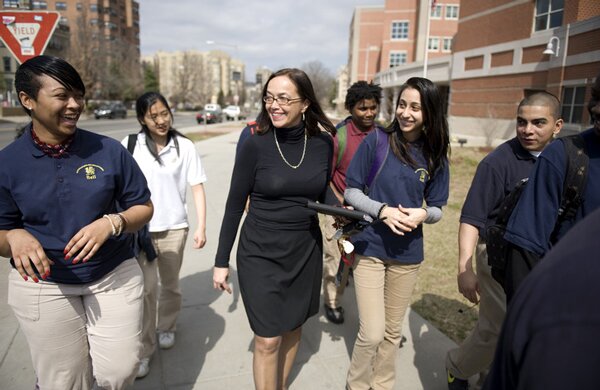
The Visionary: How Maria Tukeva helps immigrants succeed in D.C. schools
By V. Dion HaynesSunday,
April 11, 2010; W30
To the nervous high school senior presenting her research project in the school library, this feels like an "American Idol" moment, and Principal Maria Tukeva is the judge she most wants to impress.
The student, Lizbeth Macias, 17, rattles off data about the slave roots of Georgetown's Mount Zion Cemetery and laments all the ways it has fallen into disrepair. She tells the judges she even volunteered as a tour guide at the historic site and shared her knowledge with visitors for the class project. But not even a quarter into her talk, Macias loses her composure.
"I'm sure I'm blushing. I'm a really, really shy person," she says, fiddling with her note cards. She pauses, sucks in a deep breath and regains control. There's good reason for her angst: She must get a passing grade on her portfolio presentation to graduate. When Macias is done, the other judge -- Denise Harrison, a manager at a local State Farm Insurance office -- offers a sweet, Ellen DeGeneres-like endorsement for the attempt at such an ambitious project. But today, Tukeva is Simon Cowell, albeit wrapped in a soft-spoken, non-sneering package. Tukeva tells Macias she was shaky on some details of a lawsuit involving the cemetery.
"One suggestion is to get more familiar with the court case. I think you were confused about who was whom," Tukeva says calmly before sending Macias off to review the case further and present again another day.
This is the Tukeva the students at Columbia Heights Educational Campus, formerly Bell Multicultural High School, know well: tough but fair. She has high expectations for them, they say, but she makes sure they have the resources they need to succeed. The portfolio project is just one of the programs Tukeva has implemented over the years to shape the school into a cross-cultural institution known for transforming poor minority students and non-English speaking immigrants from El Salvador, Ethiopia, Vietnam and about 50 other countries into scholars. Nine out of 10 seniors from the school are accepted into college.
In its near-30-year existence, the school has had numerous iterations, three names in four locations. It began as a federally funded program for troubled immigrant high school students, quickly grew into a full-fledged D.C. public school, and three years ago moved from its rodent-infested, century-old building to a gleaming new campus that now enrolls 1,300 sixth- through 12th-graders. But the school has had one constant: Tukeva. Her tenure is unprecedented in the modern world of the city's school system, where principals serve at the will of the central office and are lucky if they keep their jobs for three years, let alone three decades.
In some ways, Tukeva has been able to fly below the radar. She enjoys the background, preferring not to draw attention to herself. She works alongside parents and teachers, rather than using a top-down style. She resists taking credit, attributing the school's success to the students, parents and community members who through the years fought off the system's repeated attempts to close the school, and the corporate "amigos" who raised millions of dollars and used their political muscle to get a new campus built.
"Good organizations that survive do not just depend on a leader that's out in front," she says. "It's not healthy for an organization to develop that way."
In a show of confidence, D.C. Schools Chancellor Michelle Rhee in August 2008 added Lincoln Middle School -- the feeder school that shares the new campus -- to Tukeva's responsibilities as principal. Now, the low-key leader is working to do for the middle school what she has done for the high school.
***
Tukeva was not long out of graduate school, working as an administrative assistant at a Hispanic mental health agency in Northwest Washington -- called Centro Hispano de Salud -- in the late 1970s, when she began noticing similar complaints from immigrant parents: Their children had been good students in their native country but were being referred to special education by their schools. That was before bilingual education courses were widely offered, and Tukeva knew the schools simply didn't know what to do with the students. At the same time, Tukeva said, word was circulating that some schools were asking for students' green cards, discouraging many from enrolling. She believed strongly that the school system was disenfranchising immigrants from the education process.
"They were being mislabeled," says Ricardo Galbis, the center's director at the time. The school system "lacked the cultural competence to see what was normal and abnormal."
The complaints resonated with Tukeva, who grew up in Pennsylvania with a father of Finnish descent and a mother from Spain. Tukeva was in sixth grade when her dreams were dashed by a teacher who wouldn't believe she was capable of writing a poem she'd authored.
"So I was in the lunchroom, and she was telling all the teachers at the lunch table: 'She copied this poem. She could never write it herself. She doesn't have the ability to do that,'" Tukeva recalls, fingering her thin-rimmed glasses. Her narrow face is framed by straight, shoulder-length brown hair. "Up until then, I thought I wanted to be a writer and a poet. It's the kind of thing that happens, and you get over it, but at the time it was really ..." Her voice trails off. "School was an uncomfortable place for me," she continues. "The teacher had low expectations for me. That made me want to be involved in a school where that would never happen to anybody."
After earning a degree in Spanish literature and journalism at Pennsylvania State University, Tukeva received a master's degree in linguistics and bilingual education at Georgetown University. She then landed the job at Centro Hispano de Salud. When she moved on to work as an educational specialist developing curricula for dropout prevention programs targeting Hispanics nationwide, she kept the complaints she'd heard from the immigrant parents in the back of her mind. Eventually, she started thinking about starting her own alternative high school.
Tukeva worked with a team of educators and used as the model a successful alternative school that mainly served black students in Philadelphia. The Department of Labor funded the experiment, and in 1981 Tukeva launched the Multicultural Career Intern Program. She obtained permission from the school system to use space at the Marie Reed Learning Center in Northwest Washington and to recruit Hispanics who had either dropped out or were on the verge of dropping out, essentially the students the schools didn't want. Forty students enrolled, and Tukeva served in every role: executive director, principal, teacher, curriculum developer and fundraiser.
About the same time, the population in Columbia Heights, Mount Pleasant and Adams-Morgan was changing dramatically. In the two decades following the 1968 riots sparked by Martin Luther King Jr.'s assassination, the neighborhoods had transformed from mostly white to predominately black and were becoming heavily Latino. By 1987, the city would have 80,000 immigrants from Central America alone, mostly El Salvador, local officials said at the time. The program grew rapidly, and a nonprofit board Tukeva formed to support it raised money to supplement the federal grant. But Tukeva pushed to become a part of the D.C. school system and in 1989 merged with Bell Career Development Center in Columbia Heights, forming Bell Multicultural High School. Tukeva kept the nonprofit board, which continued raising money to support the school.
Some of the teens Tukeva enrolled had fled poverty and civil wars with their families and had tragic stories. To this day, Rosalba Bonilla-Acosta, 42, remembers vividly when three military men in green uniforms and rifles took over her family's home in El Salvador and used it as a staging area for their battle with the guerrillas. Then 15, she crouched on the kitchen floor with her father, older sister and younger brother as the soldiers and guerillas exchanged gunfire. She also watched in horror when a bullet struck her 12-year-old brother in the face.
He survived, but when their father died two years later, the three children moved to Washington to join their mother, who had been living here since 1978. Bonilla-Acosta says she and her peers found a sanctuary at Bell -- Spanish-speaking teachers, a culturally sensitive curriculum and job internships. Tukeva also opened the school at night so parents could get English lessons and information on housing, community services and public schools. Bonilla-Acosta even met her husband, Salustio Acosta, at Bell. The school placed her in an internship at a community group called CentroNía, where she has worked the past 24 years, now serving as director of a child-care and community center. "If it wasn't for this place that supported me and gave me the guidance and gave me the coaching and role modeling, it would have been impossible to make it," she says.
When rioting broke out in the Mount Pleasant area after police shot an unarmed Latino man in 1991, the city's black leaders found themselves targets of the kinds of human rights complaints black residents had lodged against the white establishment during the civil rights movement. Tukeva joined the Latino Civil Rights Task Force and demanded more bilingual programs citywide. When a U.S. Commission on Civil Rights included such programs among its recommendations to improve conditions for the city's immigrants, Tukeva was enlisted to help. But during a budget crisis just two years later, the school board moved to close Bell and relocate students to nearby Cardozo Senior High.
The community, which believed the city was dragging its feet in implementing the civil rights commission's recommendations, marched in the streets and packed school board meetings, prompting the administration to back down. Students, supported by Tukeva, demonstrated again when it seemed the city had broken its promise to add a gym and cafeteria to the rundown school. They protested once more in 1997, when a judge temporarily closed Bell and other city schools because of leaky roofs. The school's nonprofit board, which included some powerful and wealthy people Tukeva had recruited, began searching for a solution to the school's infrastructure problems. First, the board sought to acquire a ratty auto repair shop next door for expansion. But the board dropped that idea in favor of building a new school, despite resistance from a cash-strapped school system and a city reluctant to provide land in the gentrifying neighborhood.
"I got some building experts to tour the building with me. The consensus was it was not worth trying to upgrade the 100-year-old building," said then-board chairman Richard England, president of the Lois & Richard England Family Foundation and former chairman of the defunct Hechinger Co. He contributed $1 million for the new building, helped raise $5 million more and negotiated with the city and school system to build the school.
Tukeva sold him on her goals, he said. "But she's not been a headline seeker. Her interest is in doing what's best for the child." Still, the project initially generated criticism among some Latinos because it destroyed a soccer field that had been a popular gathering spot for neighborhood youths -- a public space that has not been replaced.
"There was a lot of disappointment," says Olivia Cadaval, curator of the Smithsonian Institution's Center for Folklife and Cultural Heritage. A new field, sitting behind a wrought-iron fence, is confined largely to the school's championship soccer team. Tukeva "has an enclave there and decides who comes in and who doesn't," Cadaval said.
These days, Tukeva spends much of her time at the middle school, which has a long history of dysfunction and underachievement. Shortly after moving onto the new campus, the middle school students damaged the property, kicking in lockers, scrawling graffiti on computer terminals and destroying bathroom sinks.
Tukeva made dramatic changes right away, splitting boys and girls into separate classes and introducing the school system's Capital Gains program, which pays students for good grades and behavior. Already, Tukeva said, she has noticed a significant drop in the number of students referred to the office for discipline problems. Now, every day at lunchtime, she assigns herself to cafeteria duty to get to know her middle school students.
She also is working with her administrators to develop a middle school version of the high school portfolio. "This will give them a sense they are making a big transition to ninth grade," Tukeva said. "And they will see what will be expected of them."
V. Dion Haynes, a Washington Post economics writer, covered the D.C. public schools from 2005 to 2008. He can be reached at haynesd@washpost.com